
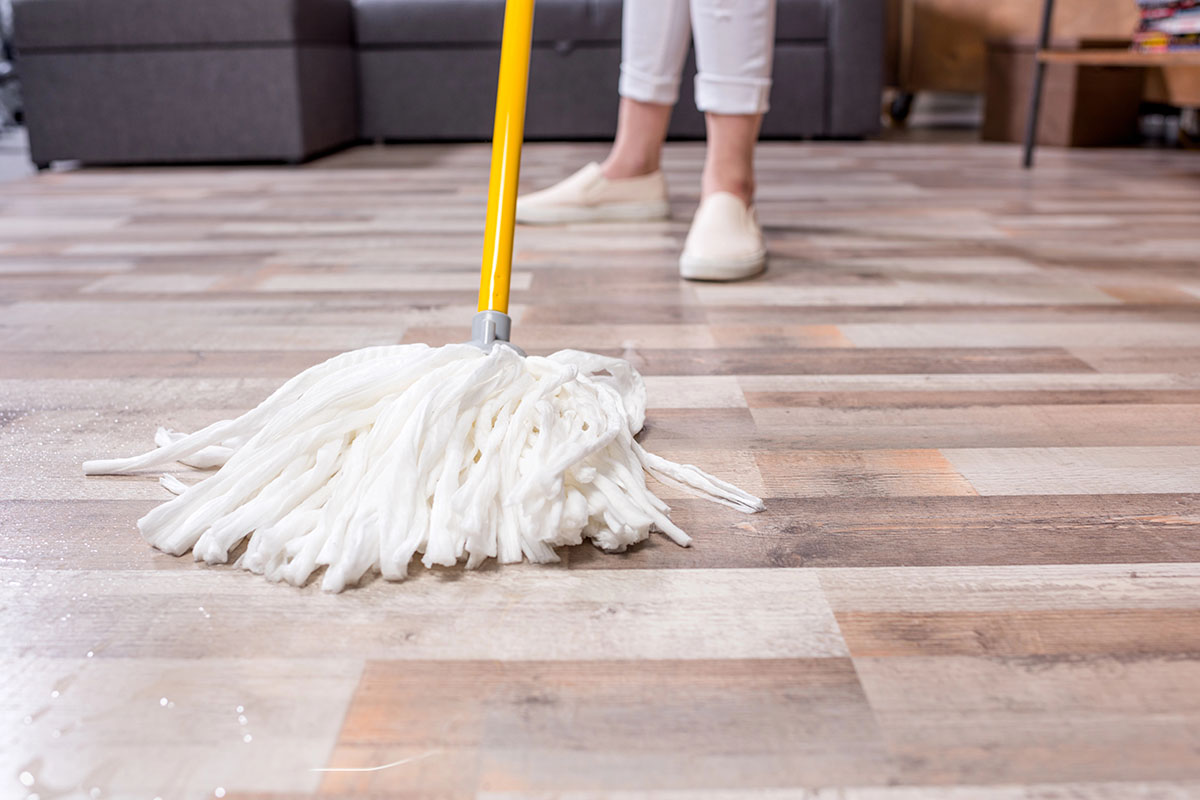
A mopped floor reads as clean. Clients notice it. Employees work better in it. Facility managers point to it during inspections. That perception is the whole point of the cleaning budget, which is exactly why it matters when the process is quietly working against you.
The string mop and bucket have been standard issue in janitorial closets for over a century, but what actually happens during a mop cycle tells a different story than the damp, pine-scented floor left behind. Cleaning researchers call it soil transfer: the mop doesn’t remove contaminants so much as redistribute them. The limitation isn’t the effort of the staff. It’s the physics of the tool.
The Soil Transfer Problem
It starts well. Fresh bucket, clean solution, unused mop head. First pass across the floor: the mop picks up dust, grit, and microbes effectively. Then comes the problem.
1. The contaminated mop head goes back into the bucket.
That clean water is now carrying whatever just came off the floor, soil, bacteria, whatever was tracked in since the last cleaning. Every subsequent dip draws from that same contaminated reservoir.
2. The wrung-out mop goes to the next section of floor.
At this point it isn’t cleaning, it’s applying a thin layer of diluted contamination from the previous section to this one. The cleaning solution masks the smell. It doesn’t neutralize what’s being deposited.
3. By the time the bucket is halfway through a room, the water has turned a recognizable gray-brown.
The active concentration of cleaning solution has dropped. The mop head is saturated with what it picked up rather than what it removed. The floor at pass thirty is dirtier than the floor at pass one.
The visual result looks clean, damp, uniform, faintly scented. The microbial result is often the opposite. Research using ATP luminometry, which measures organic residue including bacterial material, has found that string-mop cleaning doesn’t reliably reduce floor contamination and in some cases can increase measured bacterial load compared to the pre-mop baseline. You’re spreading the contamination more evenly, not lifting it out.
Other Ways Mopping Fails
The bucket contamination is the biggest problem, but not the only one.

Cotton string mops hold moisture. Left damp between uses, which is standard in most facilities, they become incubators. Staphylococcus, E. coli, and other pathogens grow readily in wet fiber at room temperature. A mop stored overnight in a utility closet can introduce more bacteria to the floor than it removes, even with fresh solution in the bucket.
Technique compounds the problem. The figure-eight pattern many staff use pushes debris toward the center of each stroke rather than capturing it. Skipping dry sweeping beforehand makes it worse, loose grit turns into abrasive slurry, and you end up grinding small particles across the surface rather than lifting them.
Using the Wrong Solution. Too much soap, even a few extra squirts past the label’s dilution ratio, leaves a film that turns tacky once dry and pulls in dust and foot traffic grime. The chemical type matters just as much: an alkaline cleaner on acid-sensitive stone can etch the surface, while a neutral cleaner used in a food-service or healthcare setting may not meet required disinfection thresholds.
That’s the explanation for the hazy streaks and faint stickiness you notice after a floor dries, residue and redistributed grime, not a clean surface. The floor looks mopped. The contamination largely stayed put.
The Microfiber Alternative

Microfiber breaks the dirty-mop cycle because of how the fiber actually works. Cotton mop loops are thick and round, they push dirt more than they grab it. Microfiber is built from split filaments so fine they create enormous surface area relative to their weight, and those split edges act as mechanical hooks that pull dirt, bacteria, and allergens off the floor rather than smearing them into a thin film.
Most microfiber flat-mop systems use swap-out pads. One clean pad per zone, set aside for laundering once used. That design sidesteps the contaminated-bucket problem entirely. The catch is that microfiber only keeps working if it’s washed at high temperature, typically at or above 60°C (140°F), and never with fabric softener, which clogs the split fibers. Managing that washing protocol consistently in-house is harder than it sounds, which is why most commercial facilities find outsourcing the laundering more practical than running it themselves.
The Role of High-Quality Floor Mats
The most efficient way to keep floors clean is to stop dirt before it enters the building. Industry figures consistently estimate that roughly 80% of a building’s soil arrives through the front door on shoe soles, the exact share varies by traffic type and building use, but the directional point holds. A mop, no matter how good, can only react to what’s already on the floor.
Scraper mats at the entrance pull grit and moisture from shoe soles before visitors reach the main floor. That first barrier cuts the debris load your mopping system has to handle and reduces wear on floor finish over time. Matting and mopping aren’t competing strategies, one prevents soil from entering, the other removes what still gets through.
FAQs
How often should a commercial mop head be replaced?

For standard cotton string mops, plan on replacing the head every two to four weeks under normal commercial use, more frequently in high-traffic environments. Don’t wait out the schedule if the mop head smells sour or still looks grey after rinsing. Those are signs the fibers are retaining bacteria that rinsing alone won’t clear, and continuing to use it spreads contamination rather than removing it.
Is a two-bucket system really necessary for mopping?
A two-bucket setup, one bucket for fresh cleaning solution, one for wringing out the dirty mop, is meaningfully better than a single bucket. It keeps the wash water from becoming a contamination vehicle as quickly. That said, even a well-managed two-bucket system doesn’t approach the hygiene level of a microfiber flat-mop setup, where each pad contacts one zone and is then pulled from use.
Can I just bleach my mop to keep it clean?
Bleach does kill bacteria, but it degrades mop fibers fast, often within a few weeks of regular use. The mop starts shedding lint and losing absorbency, which makes it worse at the actual job. Professional laundering sanitizes effectively without breaking down the material.
What is the most hygienic way to clean large commercial floors?
For open areas, an auto-scrubber is the strongest option: it dispenses fresh solution continuously and vacuums up dirty water immediately, so the machine never spreads contaminated fluid back onto the floor. Where a machine can’t reach, a microfiber flat-mop system with professionally laundered pads is the next-best approach.
Does the type of flooring affect how the mop works?

Yes. Porous floors, natural stone, unsealed concrete, trap dirt in their texture and need more frequent water changes or pad swaps. Non-porous surfaces like LVP or polished concrete are easier to clean but will show every smear and chemical streak clearly if the mop isn’t clean going in.
If the mop and bucket are so bad, what is the alternative?
The core problem with mop-and-bucket is that it moves soil around rather than removing it. Microfiber flat-mop systems solve this with one rule: one pad per area, never reused. Each zone gets a fresh, pre-moistened pad, and soiled pads go straight into a laundry bag, never back into the cleaning solution. That single discipline eliminates cross-contamination at the source.
Is changing the mop water frequently enough to solve the problem?
It helps, but the mop head is still the problem. Even with fresh water, a mop that has wiped several rooms has absorbed bacteria, grease, and debris into its fibers, and that contamination transfers to every surface it touches next. A dual-bucket system, which separates clean solution from dirty rinse water, cuts recontamination meaningfully, but it does not fix the underlying issue of running the same saturated head across an entire facility.
How can I tell if my floors are being properly cleaned?
Start with the basics: no streaks, no haze, no sticky feel after drying. But visual inspection only goes so far. An ATP meter measures adenosine triphosphate, a biological marker present wherever microbial activity exists, and returns a surface reading in seconds. Professional hygiene providers use them routinely to document before-and-after results, giving you a scientific confirmation that cleaning actually reduced microbial load rather than just making the floor look presentable.
Doesn’t the disinfectant in the mop water kill all the germs?

Not in a dirty bucket. Disinfectants require both adequate contact time and a low enough soil load to work, exceed that soil threshold and the active chemistry gets neutralized before it can do its job. A bucket that has already cleaned several rooms carries enough suspended organic matter to significantly cut disinfectant efficacy. The sequence matters: clean first, then disinfect. Skipping the cleaning step and expecting disinfectant to carry the load is how floors end up appearing clean while still harboring pathogens.
A Strategic Approach to Business Hygiene
The gap between a clean-looking facility and a genuinely hygienic one comes down to soil removal versus soil redistribution. A traditional loop mop picks up contaminants at one surface and deposits most of them at the next, infection control research has consistently documented pathogen transfer from mop heads to previously cleaned areas. Microfiber systems and color-coded single-use protocols break that pattern by mechanically capturing particles rather than moving them around. The objective isn’t to pass a visual inspection. It’s a measurably lower microbial load at the contact points where transmission actually happens.
If your current program relies on a mop and bucket, your facility is probably cleaner-looking than it is clean. We assess your actual contamination risk, high-touch surfaces, cross-zone transfer points, protocol gaps, and match specific tools and procedures to what your building needs. You get a documented baseline and a verifiable improvement target, not a generic upgrade pitch.