
Hand soap is one of those purchasing decisions that gets made once, then mostly forgotten, until it becomes a problem. Run out during a restaurant lunch rush, stock a watery formula that leaves hands feeling tight, or let an open-refill dispenser get contaminated, and people notice. In high-traffic facilities, the soap and dispenser system you choose affects your supply costs, how often staff have to service restrooms, and the impression your space makes on anyone who walks through. It’s not glamorous, but it’s not minor either, especially when you consider the standards for San Marcos restroom sanitation.
The cheapest soap per gallon is rarely the cheapest option overall. Cost-per-wash, dispenser compatibility, contamination risk, and maintenance time all factor into what “best” actually means for your building. The right question isn’t “what’s cheapest?”, it’s “what delivers the lowest total cost with the least friction for my staff and my users?” We help you find the right janitorial supplies in San Marcos TX.
Key Factors in Choosing a Commercial Soap System
Three things drive most of the real-world difference between soap systems: how much each wash actually costs you, how the dispenser operates, and what the experience is like for the people using it.
1. Cost-in-Use vs. Upfront Price
Price per gallon tells you almost nothing useful. What matters is cost per hand wash, and that depends on formula concentration and how much the dispenser releases per press. A foaming soap cartridge that costs more upfront can still deliver two to three times the hand washes of a bulk liquid refill, depending on the product and dispenser pairing. Run the per-wash math before comparing sticker prices.
2. The Dispensing System

The dispenser is where most facilities leave money on the table. Sealed cartridge dispensers cost more than bulk-fill alternatives, but they pay for themselves in two concrete ways: they prevent soap contamination (a real problem with open-reservoir systems), and they take seconds to swap out versus the time-consuming, often messy process of pouring soap into a reservoir. In a facility servicing dozens of restrooms daily, that difference in labor time compounds fast.
3. User Experience
Soap that leaves hands feeling dry or smells harsh gets avoided, which means people skip washing or, in a workplace setting, start complaining to facilities. A quality foam soap with a neutral or mild scent hits the right balance: effective enough to clean, gentle enough that no one thinks twice about using it. Most general-purpose foam soaps clear this bar; the ones that don’t tend to show up in maintenance logs as “soap complaints.”
Foam vs. Liquid Soap
For most facility managers, the real decision is foam vs. liquid. In high-traffic restrooms, foam wins, not as a matter of preference, but because the numbers on waste, cost-per-wash, and maintenance time consistently favor it.
Foam Soap
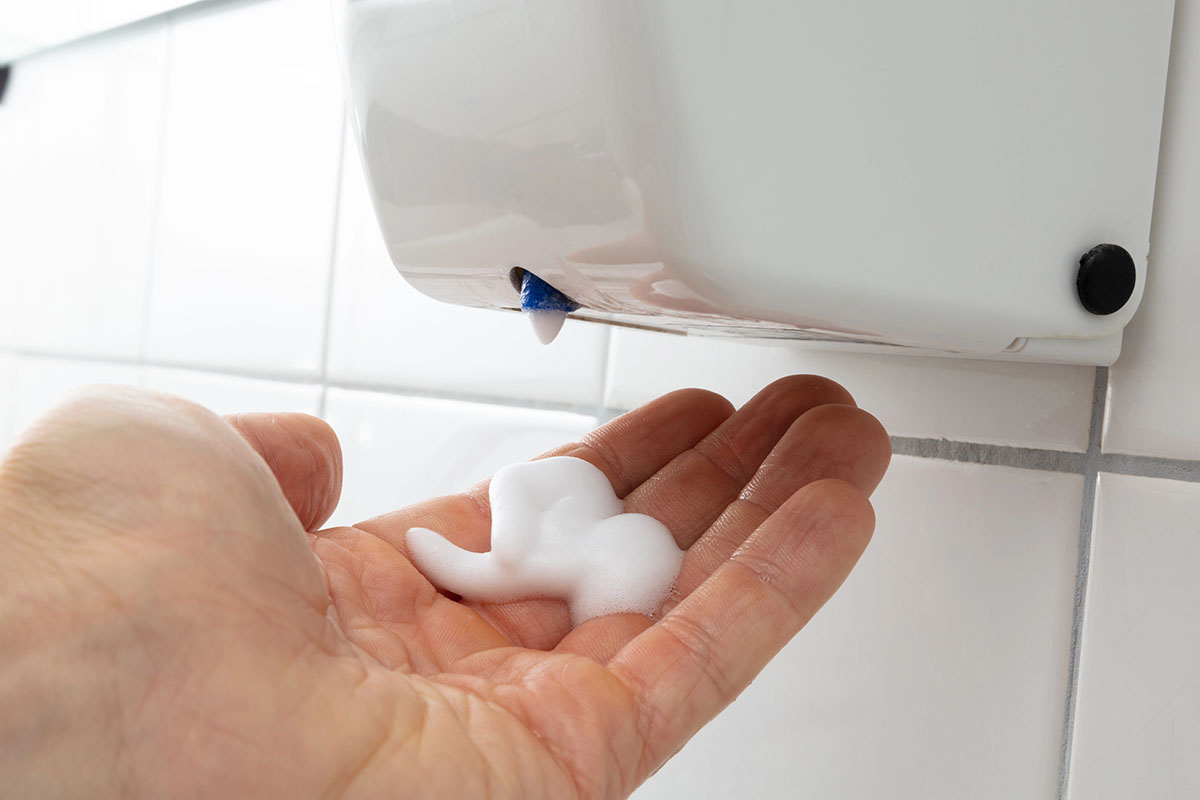
Foam dispensers pump air into a diluted liquid solution, delivering a pre-lathered dose with each press. That single mechanical difference drives most of foam soap’s practical advantages:
- Waste Reduction: Each press delivers a fixed, already-lathered dose. Users don’t need to take more, and they’re less likely to, which keeps per-wash consumption predictable and controlled.
- Lower Cost-in-Use: Less product per wash means more washes per cartridge. In a busy restroom cycling through hundreds of uses a day, that adds up to meaningful savings over a billing cycle.
- Water Savings: Because foam soap is already aerated at the dispenser, hands get full coverage with a quick rinse, liquid soap needs more time and water to build a comparable lather. Commercial hygiene suppliers commonly cite water reductions of 30-45% per wash compared to liquid, though the actual figure varies by dispenser model and usage pattern.
- Reduced Mess: Foam clings to skin rather than running off. A pump of liquid soap drips from fingertips to countertop before most people even get their hands under the tap. Foam doesn’t behave that way, it stays where it lands, which keeps sink areas noticeably cleaner between wipe-downs.
Liquid Soap

Liquid soap cleans hands. But in a commercial restroom where dozens of people cycle through each hour, its limitations compound quickly:
- Higher Waste: Most people press a liquid soap pump two or three times out of habit, even when one dose would do the job. That reflex alone can double product consumption against what the usage math predicted when you bought the cartridge.
- Messy and Inefficient: Liquid soap runs. It drips down dispenser nozzles, pools on countertops, and turns tile floors slick, which is both a cleaning burden and a slip liability that foam dispensers largely avoid.
- Higher Cost-in-Use: When you account for over-dispensing under real-world conditions, a cartridge that should last a week on paper can disappear in four or five days. That gap between projected and actual consumption is where liquid soap quietly inflates your supply budget.
In high-traffic restrooms, the math favors foam: lower waste per wash, fewer refills, and a cleaner sink area. Liquid soap can still make sense in lower-volume settings where upfront cost is the main constraint, but it rarely comes out ahead on total cost of use once you count labor and product burn rate.
The Hidden Costs of Restroom Maintenance
Price per gallon is the wrong metric for restroom soap. The actual cost of a hygiene program shows up in four places:
- Labor: How many staff-minutes go toward checking and refilling dispensers each day, and what does that time cost at your current wage rate?
- Waste: How much product leaves the building without cleaning anyone’s hands?
- Repairs: Are lower-cost dispensers failing under daily volume, and what does each replacement or service call actually run?
- Perception: How often is your dispenser empty or malfunctioning when a customer reaches for it, and what does that impression cost in repeat business?
A managed hygiene service addresses most of these gaps directly. Dispensers get serviced on a set schedule, restocks arrive before inventory runs out, and the soap itself is formulated for commercial volume, concentrated and portioned to reduce per-wash cost, not diluted to lower the sticker price. For many facilities, the service fee is offset within months by reduced staff time and lower product churn.
FAQs
Is foam soap better than liquid soap for businesses?

For high-traffic businesses, foam typically wins on cost per wash and water use. The soap is pre-aerated at the dispenser, so a single pump covers both hands, users don’t need to pump twice or spend extra time building a lather. That translates directly to fewer refills, less product down the drain, and a cleaner counter between cleanings.
Are touchless soap dispensers worth the investment for small businesses?
Yes, and the return shows up faster than most owners expect. Touchless dispensers eliminate one of the most-touched surfaces in any restroom, which has real implications for cross-contamination, not just appearances. The fixed-dose mechanism also means no one takes three pumps when they meant one: product lasts longer, the counter stays drier, and refill frequency drops.
What is the difference between bulk soap and sealed cartridge systems?
Bulk soap is poured from a large container into a permanent reservoir. Topping off a reservoir that still holds old product is a documented contamination risk, the CDC and FDA have flagged open refillable dispensers as a source of bacterial growth in healthcare and food-service settings. Sealed cartridge systems sidestep this entirely: the soap never contacts air or a dirty reservoir, and each replacement is a full swap rather than a pour. Cartridges cost more per ounce, but the hygiene consistency and reduced staff handling time typically justify the difference in commercial settings.
Should we use antibacterial soap in our public restrooms?
Standard soap is the right call for most offices and public restrooms. The FDA’s 2016 consumer antiseptic rule found insufficient evidence that antibacterial additives outperform plain soap and water for routine hand hygiene, and subsequently removed 19 common antibacterial ingredients from the market. Beyond efficacy, frequent users tend to prefer soaps with skin conditioners, washing hands eight to ten times a day without moisturizing agents dries out skin quickly, which discourages proper handwashing habits over time.
How do we prevent soap dispensers from leaking on the counter?
Most counter leaks trace back to two causes: a worn pump spring or a cracked reservoir seam. Manual pumps that handle hundreds of uses a day wear out fast, the spring loses tension and soap seeps between uses. Switching to a sealed cartridge-based or touch-free automatic dispenser removes that failure point, since neither relies on a manually compressed pump head. If you’re running bulk-fill dispensers, a quarterly check by your hygiene service contact is usually enough to catch a failing unit before it becomes a counter mess.
Is antibacterial soap necessary for a commercial restroom?
The CDC and FDA both say no. The FDA banned triclosan, the active ingredient in most antibacterial soaps, from consumer products in 2016 after manufacturers couldn’t demonstrate it outperforms plain soap under real-world conditions. Standard soap with 20 seconds of scrubbing removes the same pathogens. There’s also a resistance concern: regular use of antibacterial formulas in high-traffic environments can contribute to antibiotic-resistant strains over time. A standard foam or liquid soap handles the job without that tradeoff.
What is the difference between commercial soap and what I buy at the grocery store?
The gap is mostly in the dispensing system, not the soap formula. Grocery store pump bottles are built to handle a few uses a day at home. A commercial dispenser in a busy office or restaurant handles 200 to 500 pump cycles daily and needs to stay calibrated so each press delivers a consistent dose. Commercial soap is formulated to match its paired dispenser, controlling portion size and preventing clogging. The hardware reflects that demand: metal internals, standardized cartridge interfaces, and components a technician can swap without replacing the whole unit.
How do sealed dispensers improve restroom hygiene?
Open, bulk-fill dispensers have a documented contamination problem. Research published in Applied and Environmental Microbiology found that bacteria introduced during refilling can multiply in the standing liquid inside an open reservoir, and in tested cases, washing with the contaminated soap actually raised hand bacteria counts rather than lowering them. Sealed cartridges close off that entry point. The soap stays in a factory-sealed container until it’s dispensed, so there’s no contamination window between restocking visits.
Does the scent of the soap matter?
Yes, and it catches more facility managers off guard than it should. Fragrance is one of the most common triggers for contact dermatitis and respiratory irritation, the American Contact Dermatitis Society lists fragrance mix among its top allergens. In a high-traffic restroom serving a broad range of users, a heavily scented soap creates a real accessibility issue. The practical choice is fragrance-free, or a soap with a minimal, functional scent that signals clean without lingering on hands or in the air.
Making the Right Choice: A Managed Hygiene Program
The real management challenge isn’t which soap to buy, it’s the ongoing overhead: tracking inventory, finding empty dispensers mid-shift, and dealing with equipment failures at the wrong moment. For facilities with steady foot traffic, a managed hygiene program usually makes more operational sense than self-supply. A service provider handles the equipment, monitors usage, and restocks on a schedule matched to your building’s actual demand, which means fewer empty dispensers and no time lost chasing soap orders.
If managing soap inventory, chasing empty dispensers, or dealing with equipment breakdowns is taking time your team doesn’t have, our hygiene specialists can help. We’ll assess your facility’s traffic, recommend the right dispensing system, and take restocking off your plate. Reach out to get started with our San Marcos office cleaning.